

Table of Contents
1. What Is a Mold Insert?
In injection mold design and manufacturing, mold inserts are a very common structural solution.
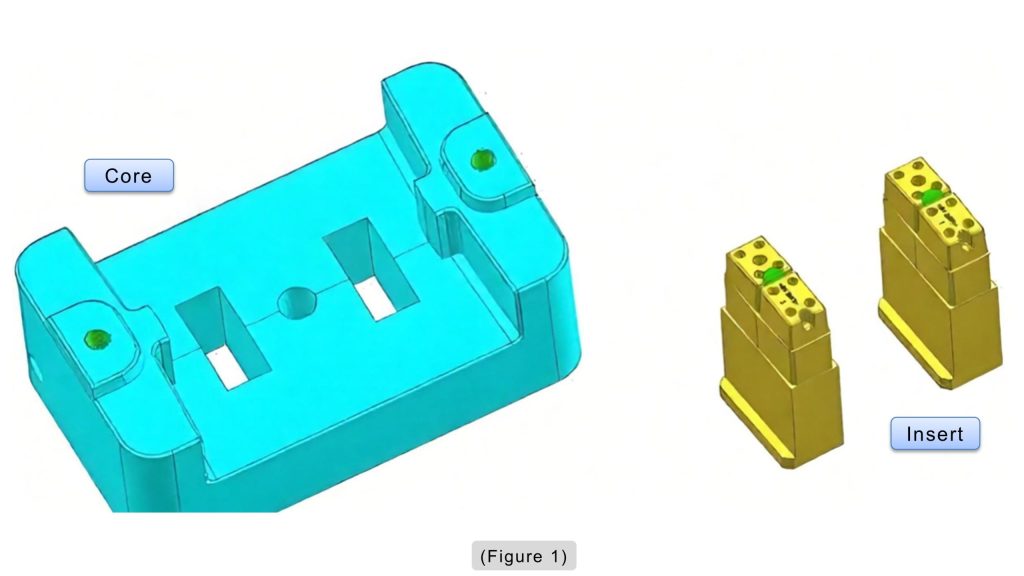
Simply put, when a core or cavity block is not machined entirely from a single piece of steel, but instead consists of a main steel block combined with additional fitted components, those components can be referred to as mold inserts.
Mold inserts may also be called core inserts, cavity inserts, mold insert blocks, or simply inserts, depending on the mold structure and the terminology used by the design team.
The purpose of using mold inserts is not simply to divide a mold into multiple components. In most cases, inserts are introduced to solve practical mold design and manufacturing issues, such as difficult machining, poor venting, insufficient local strength, inconvenient maintenance, or the need for future mold modifications.
Although adding inserts may slightly reduce the overall rigidity of the mold structure, a properly designed insert can improve local manufacturing efficiency, simplify maintenance, and make future mold changes much easier.
2. When Should Mold Inserts Be Used?
Mold inserts are commonly used when a specific area of the mold requires special consideration for machining, venting, polishing, maintenance, product variation, or heat dissipation.
The following are common situations where mold inserts may be considered in injection mold design.
(2-1) Reducing Material Usage and Manufacturing Cost
The required steel stock thickness on the core side is often determined by the highest feature on the molded part.
If only one localized area of the product has a raised feature, especially when the feature has a relatively regular geometry, it may not be necessary to increase the thickness of the entire mold core block.
Instead, the raised area can be designed as a separate insert. This allows the main core block to remain at a more reasonable size, helping reduce steel consumption, machining time, and overall manufacturing cost.
(2-2) Avoiding Inefficient Machining
Among common mold manufacturing processes, EDM, or Electrical Discharge Machining, is generally slower than many mechanical machining processes.
In some mold structures, certain features can only be produced by EDM because of depth, narrow geometry, sharp corners, or machining accessibility limitations. When this happens, the required machining time may increase significantly.
By separating these difficult areas into individual inserts, moldmakers gain more flexibility in selecting machining processes. This can improve manufacturing efficiency and make the mold easier to produce.
(2-3) Improving Venting in Deep Rib Areas
Plastic parts with deep ribs, deep grooves, or long and narrow features are more likely to experience poor air evacuation during injection molding.
If trapped air cannot escape smoothly, molding defects such as burn marks, short shots, or cosmetic issues may occur.
When it is difficult to machine a vent directly into the core or cavity block, the area can be divided into separate inserts. The fitting surfaces between the insert and the surrounding mold steel can then help provide a venting path.
This approach can improve air evacuation and support more stable melt filling during injection molding.
(2-4) Improving Grinding Accessibility and Machining Accuracy
Grinding can provide high dimensional accuracy and better surface quality, but not every mold feature can be conveniently ground when it is machined directly into a one-piece core or cavity block.
If a specific mold area requires tighter dimensional tolerance or better surface finish, designing that area as a separate insert can make machining, grinding, and inspection easier.
Because the insert can be processed independently, this approach can help improve dimensional consistency and overall product stability.
(2-5) Supporting Interchangeable Product Variations
Some products are manufactured using the same mold but differ only in small details, such as logos, text, date codes, symbols, or localized features.
Producing an entirely new mold for each product variation would significantly increase tooling cost.
By using interchangeable inserts, manufacturers can switch between different product versions while continuing to use the same primary mold structure. This gives the mold greater flexibility for production changes and product updates.
(2-6) Simplifying Mold Polishing and Maintenance
Deep and narrow mold features can be difficult to access during mold polishing, hand finishing, or repair.
If these areas are machined directly inside a one-piece core or cavity block, polishing may become time-consuming and may also increase the risk of affecting adjacent mold surfaces.
When these areas are designed as removable inserts, they can be taken out and worked on separately. This makes machining, polishing, repair, and maintenance much easier.
(2-7) Allowing for Future Mold Modifications
Certain areas of a molded part may be more prone to wear, while other features may require tight dimensional control and may need adjustment later in the mold’s service life.
Designing these areas as inserts from the beginning makes future mold modifications much easier.
Instead of modifying the entire core or cavity block, moldmakers can adjust, repair, or replace only the affected insert. This helps reduce maintenance risk, shorten modification time, and improve the flexibility of the mold structure.
(2-8) Improving Local Heat Dissipation
For beryllium copper inserts, one of the main considerations is usually heat transfer.
If a localized area of the mold does not dissipate heat effectively and this affects molding stability, an insert made from a material with suitable thermal properties may be used to improve local heat transfer.
However, insert material selection should always be evaluated according to product geometry, mold conditions, machining requirements, strength requirements, and overall tooling cost.
3. Related Mold Insert Design Videos
The following videos provide additional explanations related to mold insert design.
These videos cover insert design methods, structural applications, and practical examples. They can be used together with this article to better understand the key considerations and real-world applications of mold inserts in injection mold design.
4. References and Additional Resources
This article draws on relevant technical books, literature, research materials, and publicly available sources. The primary references have been compiled in the “References and Book Sources” video for readers who wish to explore the subject in greater depth.
Any images, charts, technical data, or published materials cited or reproduced in this article remain the property of their respective authors, publishers, or other rights holders.
[1] Zhao, Longzhi, Zhao, Mingjuan, and Fu, Wei. Practical Handbook of Modern Injection Mold Design. China Machine Press, October 2012.
[2] Li, Huilai. Practical Examples of Product Structural Design. Publishing House of Electronics Industry, July 2013.
[3] Zhong, Yuan. Product Design Guidelines for Manufacturing and Assembly. China Machine Press, October 2011.
▶ Complete References and Source Materials — For more details, please watch the following video.